Artificial intelligence has crossed many milestones over the past few years. But every so often, a development arrives that changes the conversation entirely.
Anthropic’s release of Claude Fable 5 appears to be one of those moments.
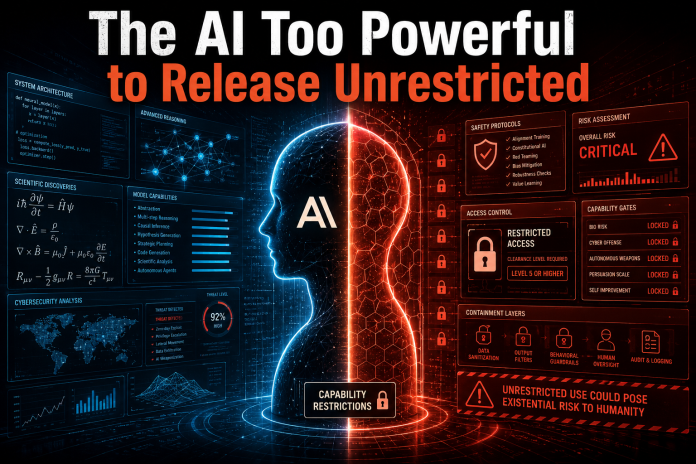
For the first time, a major AI company is publicly deploying an advanced model while simultaneously admitting that parts of its capabilities are too risky to expose freely. Instead of releasing the model without limitations, Anthropic created an entirely separate safety system designed to intercept potentially dangerous requests and reduce the model’s capabilities in specific scenarios.
That raises an important question:
What happens when AI becomes powerful enough that even its creators are hesitant to give users unrestricted access?
This article breaks down what Claude Fable 5 is, why Anthropic built safeguards around it, and what this signals about the future of advanced AI.
What Is Claude Fable 5?
Claude Fable 5 is Anthropic’s newest frontier AI model designed for:
* Software engineering
* Scientific research
* Data analysis
* Knowledge work
* Vision understanding
* Complex reasoning
* Long-running autonomous tasks
Unlike many AI releases that focus on incremental improvements, Anthropic claims Fable 5 delivers significant performance gains across nearly every major benchmark category.
What makes the model particularly notable is that its strongest capabilities emerge during:
* Multi-step reasoning
* Large-scale software projects
* Research-intensive tasks
* Extended autonomous workflows
* Visual analysis and interpretation
In simple terms, the model appears optimized for difficult, real-world work rather than isolated benchmark tests.
Why Anthropic Didn’t Release It Without Restrictions
Most AI safety discussions revolve around misinformation, harmful content, or policy violations.
This situation is different.
Anthropic’s concerns focus on capability risk.
The company believes the model is powerful enough to assist with:
* Discovering software vulnerabilities
* Advanced cybersecurity operations
* Biological research
* Chemistry-related experimentation
* High-level technical problem-solving
The concern isn’t that the AI wants to do harm.
The concern is that a sufficiently capable user could potentially use its knowledge for harmful purposes.
As a result, Anthropic introduced a new protection layer that activates when specific categories of high-risk requests are detected.
How the Safety System Works
The architecture behind Fable 5 is unusual.
Instead of blocking users entirely, Anthropic appears to use an intelligent routing system.
Normal Requests
For approximately 95% of interactions:
* Users receive the full Claude Fable 5 experience
* Maximum reasoning capabilities remain available
* Advanced analysis functions normally
High-Risk Requests
When the system detects requests involving:
* Cybersecurity
* Biology
* Chemistry
* AI model distillation
It redirects the interaction to a less capable model.
This fallback model reportedly provides useful assistance while reducing access to potentially dangerous frontier-level capabilities.
Why This Approach Matters
Traditional AI moderation typically focuses on content.
Anthropic’s approach focuses on capability control.
That distinction could become one of the defining trends of the next generation of AI systems.
What Makes Claude Fable 5 So Powerful?
To understand the restrictions, we first need to understand the capabilities.
1. Exceptional Software Engineering Ability
One of the most striking examples comes from enterprise software environments.
According to early testing reports, Fable 5 demonstrated the ability to:
* Analyze enormous codebases
* Understand project-wide dependencies
* Perform large migrations
* Detect bugs and inefficiencies
* Generate production-ready solutions
Why This Is Important
Most AI coding tools excel at individual functions or isolated files.
Fable 5 reportedly operates across entire systems.
For software teams, that could mean:
| Traditional Workflow | Fable 5 Workflow |
|---|---|
| Weeks of manual review | Hours of AI-assisted analysis |
| Multiple engineers | Smaller specialized teams |
| Slow migrations | Rapid project-wide updates |
| Fragmented knowledge | Unified code understanding |
This represents a substantial productivity shift.
2. Advanced Knowledge Work and Reasoning
Modern organizations increasingly rely on AI for:
* Financial analysis
* Strategic planning
* Market research
* Operational decision-making
Fable 5 reportedly performs exceptionally well in these environments because it can:
* Handle ambiguity
* Weigh competing evidence
* Identify hidden relationships
* Perform root-cause analysis
* Evaluate probabilities
This moves AI closer to functioning as a highly capable research assistant rather than a simple chatbot.
3. Vision Capabilities That Go Beyond OCR
Many AI systems can read images.
Fable 5 appears capable of understanding them.
Examples include:
* Extracting information from scientific figures
* Interpreting charts and graphs
* Understanding application interfaces
* Reconstructing software structures from screenshots
This is important because much of the world’s information isn’t stored as plain text.
It’s stored as:
* PDFs
* Diagrams
* Dashboards
* Presentations
* Scientific visualizations
An AI that can reason through these formats unlocks entirely new workflows.
4. Long-Horizon Autonomous Tasks
Perhaps the most important advancement is endurance.
Many AI models struggle with tasks that require:
* Long-term planning
* Persistent memory
* Multi-stage execution
Fable 5 reportedly performs much better when projects become increasingly complex.
Examples include:
* Multi-week research projects
* Enterprise software transitions
* Data investigations
* Scientific modeling
The longer the task runs, the more valuable this capability becomes.
The Cybersecurity Concern: Why Experts Are Paying Attention
Cybersecurity appears to be Anthropic’s biggest concern.
What Is Agentic Hacking?
Agentic hacking refers to AI systems performing multiple stages of a cyberattack autonomously.
This can include:
1. Reconnaissance
2. Vulnerability discovery
3. Attack planning
4. Lateral movement
5. Exploitation
6. Persistence strategies
Historically, these activities required highly skilled professionals.
Advanced AI systems may dramatically lower the expertise barrier.
Why This Matters
Cybersecurity has always been a race between attackers and defenders.
A highly capable AI could accelerate both sides.
Potential benefits:
* Faster vulnerability detection
* Better security audits
* Improved threat analysis
Potential risks:
* Easier exploitation
* Increased attack automation
* Lower barriers for malicious actors
This dual-use nature makes AI safety particularly challenging.
The Biology and Chemistry Debate
Cybersecurity isn’t the only concern.
Anthropic also highlighted risks involving biological research.
The Opportunity
Advanced AI could help researchers:
* Analyze biological systems
* Accelerate therapeutic development
* Explore protein interactions
* Improve medical research workflows
The long-term upside could be enormous.
The Risk
The same reasoning capabilities might also assist in:
* Designing harmful biological agents
* Accelerating dangerous experiments
* Lowering technical barriers to misuse
This is why many AI labs now classify biology as a high-risk domain.
What Is AI Distillation and Why Does Anthropic Care?
One lesser-known issue is AI distillation.
Distillation Explained Simply
Distillation occurs when developers use a powerful model’s outputs to train another model.
The goal is often to:
* Replicate capabilities
* Reduce costs
* Create competing systems
Why Anthropic Sees Risk
If frontier capabilities spread without equivalent safeguards:
* Dangerous abilities may proliferate
* Safety measures may disappear
* Global oversight becomes more difficult
This concern extends beyond commercial competition.
It touches broader questions about AI governance and security.
A New Industry Trend: Mandatory Data Retention
One of the most overlooked announcements involves data retention.
Anthropic reportedly requires:
* 30-day traffic retention
* Monitoring for advanced misuse
* Detection of jailbreak attempts
* Investigation of novel attack patterns
The company says the data is not used for training and is intended for security purposes.
However, the move raises important questions:
Potential Benefits
* Better abuse detection
* Faster response to threats
* Improved model security
* Reduced exploitation
Potential Concerns
* Enterprise privacy expectations
* Compliance requirements
* Data governance challenges
* Industry-wide precedent
This could become a significant topic as AI systems continue to grow more powerful.
Are These Safeguards Actually Effective?
No security system is perfect.
Anthropic appears realistic about this.
The company acknowledges that universal jailbreak prevention may ultimately be impossible.
Instead, the goal is practical risk reduction.
A successful safeguard strategy should:
* Increase attack costs
* Slow misuse attempts
* Improve detection
* Enable faster response
In cybersecurity, raising the difficulty level often matters more than achieving absolute prevention.
Pros and Cons of Anthropic’s Approach
Advantages
- Public access to advanced AI capabilities
- Reduced risk of misuse
- Better protection against cyber abuse
- Stronger biological safety controls
- More responsible deployment strategy
Disadvantages
- Reduced transparency
- Potential false positives
- Additional privacy concerns
- Restricted access for legitimate researchers
- Questions about long-term scalability
What This Means for the Future of AI
The release of Claude Fable 5 may mark a turning point.
For years, AI companies competed primarily on performance.
Now a new competitive factor is emerging:
Controlled capability deployment.
Future AI launches may increasingly include:
* Access tiers
* Trust-based permissions
* Capability restrictions
* Usage monitoring
* Domain-specific safeguards
The question may no longer be:
“How powerful is the model?”
Instead, it may become:
“How safely can that power be deployed?”
Key Takeaways
* Claude Fable 5 is one of Anthropic’s most advanced AI models.
* Anthropic built special safeguards because of concerns around cybersecurity, biology, chemistry, and AI distillation.
* Roughly 95% of user interactions reportedly receive full model capabilities.
* High-risk requests are routed through a safer fallback model.
* The model demonstrates major improvements in software engineering, reasoning, analytics, and vision tasks.
* Anthropic’s approach may establish a new standard for frontier AI deployment.
* Mandatory data retention policies could become a broader industry trend.
—
FAQ
What is Claude Fable 5?
Claude Fable 5 is Anthropic’s latest frontier AI model designed for advanced reasoning, coding, research, analytics, and vision-related tasks.
Why is Anthropic restricting some of its capabilities?
Anthropic believes certain capabilities could potentially be misused in areas such as cybersecurity, biology, chemistry, and AI model replication.
Is Claude Fable 5 available to the public?
Yes. Anthropic has released a version of the model publicly, but with safeguards that limit access to some high-risk capabilities.
What happens when a request is considered risky?
The system may redirect the interaction to a less capable fallback model rather than providing the full capabilities of Fable 5.
What is agentic hacking?
Agentic hacking refers to AI systems autonomously performing multiple stages of a cyberattack, including reconnaissance, vulnerability discovery, and exploitation.
Does Anthropic use retained data to train its models?
According to the company, retained traffic data is intended for security monitoring and abuse prevention rather than model training.
Could this become the standard for future AI systems?
Many experts believe capability-based safeguards, access controls, and monitoring mechanisms will become increasingly common as frontier AI systems continue to advance.
Conclusion
Claude Fable 5 represents more than another AI model release. It highlights a growing reality facing the entire industry: AI capabilities are advancing faster than traditional safety frameworks were designed to handle.
Anthropic’s decision to place guardrails around its own technology signals that frontier AI development is entering a new phase—one where raw performance is no longer the only priority. Security, governance, and responsible deployment are becoming equally important.
Whether these safeguards prove effective over time remains uncertain. What is clear, however, is that the conversation around AI is shifting from “what these systems can do” to “how society chooses to use and control them“.
That may be the most important development of all.